


The International Maritime Organization’s action (IMO) to regulate emissions from fuel production and to consider all types of greenhouse gases (GHGs) – not just CO2 – is moving slowly and not receiving much attention. But these regulatory details are probably more important than the headline-grabbing move to target net zero GHG emissions by 2050. Here’s why.
A growing proportion of global GHG emissions – 3% and climbing – come from the global shipping industry. The majority of those pollutants come from large ocean-going container ships, tankers and bulk carriers that move finished goods, raw materials, minerals and food all over the globe. Measures to curb this rise in emissions are already being enacted but the details of how they come into effect are vitally important. This article investigates these details and why they matter.
Methanol and methane are currently winning the alternative fuels race – what are the consequences?
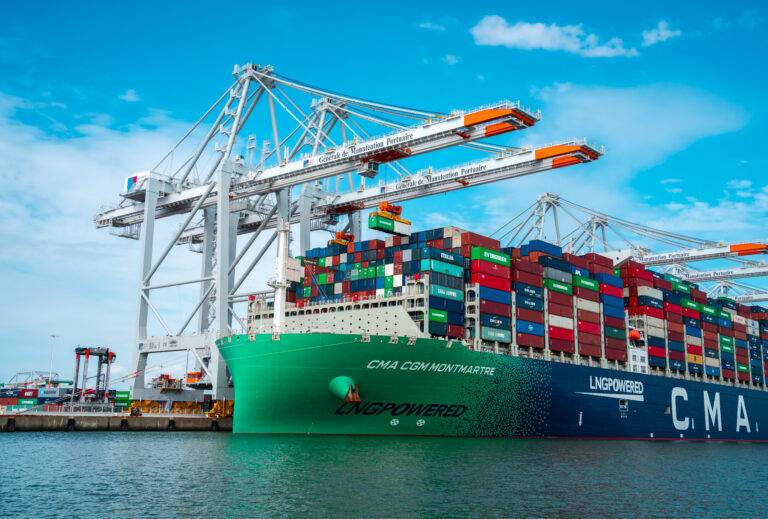
The lion’s share of new ships on order are now fueled by alternative fuels rather than traditional oil-based heavy fuel oil according to data obtained by DNV Alternative Fuels Insights. Methane (in the form of liquefied natural gas [LNG]) and methanol are the most popular choices. While this may sound like good news, zero-emission versions of these fuels are still a long way off.
Methanol and methane seem like attractive alternative fuels at first glance because they contain less carbon – the source of CO2 emissions – than conventional oil-based fuels and are relatively inexpensive. But this picture changes when all GHGs (not just CO2) are considered over the total lifecycle of fuel production and consumption.
When methanol is produced from fossil natural gas – the most common production method – vast quantities of CO2 are emitted. When these upstream CO2 emissions from methanol manufacturing are added to the exhaust emissions from a ship’s engine, methanol turns out to be worse for the environment than conventional oil-based fuel by approximately 20%. If regulations come into force that take into account the lifecycle emissions from production as well as consumption, ship operators who use methanol-powered ships will need to look for options outside of widely available fossil fuel-based methanol if they want to achieve GHG reductions – and these are currently limited.
Methane, in addition to being a clean-burning fuel, is itself a powerful GHG, so when it leaks out during production or as unburned fuel in the engine exhaust gas of ships, it counteracts the benefit of the reduction in carbon content described above. Researchers at the University of British Columbia, supported by Clear Seas, found that although measures to control methane emissions are available both in the fuel production and delivery supply chain as well as on ships, there is currently little incentive to implement them.
Methane emissions are not given high enough priority by shipowners and operators
The most common fuel choice for new cargo ships being ordered today is methane in the form of LNG. Most ship operators are hoping to reduce emissions through a transition to bio-LNG and ultimately progress to zero emissions by using e-methane in the same ships. However, decisions are being made now about which natural gas engines to install on the LNG-fueled ships being ordered and these ships will be in operation for decades. As the Clear Seas-supported research has discovered, there is currently little incentive to install the more expensive high-pressure dual-fuel engines that cut methane emissions. Action now while ships are still on the drawing board is needed or else the technology will be locked in at the shipyard with limited opportunity to retrofit.
Methane-fueled ships need to be refueled, so ship fuel suppliers are also investing in the liquefaction plants and refueling equipment needed to deliver methane fuel in the form of LNG. LNG plants with low-emission, electric-drive compressors and refueling barges with re-liquefaction equipment to capture leaking methane are available, but they are more expensive. Suppliers need to have at least the prospect of being able to charge a premium for their products or of claiming low-carbon fuel standard carbon tax credits to justify the increased investment. The alternative is leaky high-emitting infrastructure – again, in place for decades.
Emissions from the production of methanol need to be factored into international shipping emissions regulations
Shipowners may be choosing methanol-fueled ships on the assumption that they will be rewarded under the currently incomplete energy efficiency index emissions reduction measures that recently came into force. At the moment, these measures only take into account CO2 from the combustion of the fuel on the ship. Once more comprehensive regulations arrive that take account of upstream emissions from the production of methanol, shippers may have no choice but to return to burning carbon-intensive oil-based fuels.
Fixing the problem with fossil methanol is costly. One option is to mix it with enough sustainably sourced bio-methanol to reduce the reliance on high-emissions fossil fuel methanol. Another alternative is to capture and sequester some of the CO2 emitted during production. But these projects will take time to scale up and will require investment justified only if greener methanol can command a price premium in the market – a premium that will only be there if upstream emissions from methanol production are properly accounted for in regulations.
What is being done to properly regulate GHG emissions from ships?
In July 2023, the IMO adopted a revised GHG reduction strategy. IMO member states have discussed several proposals for 2030, 2040 and 2050 targets to phase out lifecycle GHG emissions, and the measures that will move the industry toward these targets. The majority of member states support the need for the international shipping sector to reach zero lifecycle GHG emissions by 2050, be aligned with the 1.5°C warming limit and avoid any out-of-sector offsets while doing so. Measures to support the shipping industry in meeting these targets that have received support include a technical element such as a GHG fuel standard that starts low and increases over time and considers lifecycle GHG emissions along with an economic element such as GHG pricing.
However, targets and measures toward mitigating the climate impacts of shipping can only be successful if they are supported by appropriate metrics that capture the full range of GHGs and the full lifecycle of alternative fuels. The Energy Efficiency Existing Ship Index (EEXI) and Carbon Intensity Indicator (CII) are energy efficiency measures that are currently only based on a CO2 intensity (CO2 emissions per transport work) metric to further contribute to the intensity targets of the initial IMO GHG Strategy. Although there have been discussions at the IMO on amending the indexes to a lifecycle metric taking into account all GHGs, not just CO2, no formal proposals on this issue have been made in recent IMO sessions.
Amendment of the existing indexes to include lifecycle GHGs, especially CO2, methane (CH4) and nitrous oxide (N2O), is critical for the international shipping sector to meet its climate targets, align with the 1.5°C temperature limit goal, incentivize the right alternative fuel(s) and technology and avoid the risks of stranded assets. Although these topics are actively being negotiated at the IMO, there is not yet a consensus.
In related news, a Lloyd’s Register report, Fuel for Thought: Ammonia, has highlighted the need for an industry-wide understanding of the operational and safety challenges surrounding the use of ammonia as a marine fuel, for its adoption as part of the maritime energy transition. Click here to read the full story.