


Lloyd’s Register Advisory has independently verified the results of Anemoi Marine Technologies’ rotor sail system, following nearly a year of testing.
Verifying the results
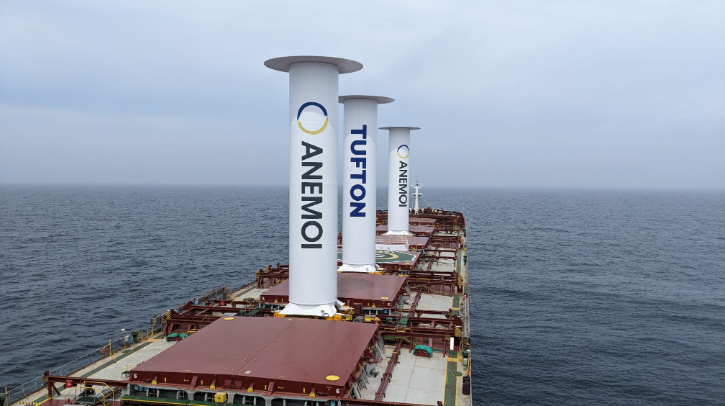
Lloyd’s Register Advisory confirmed the methodology that the wind-assisted propulsion technology company used for calculating fuel and emissions savings from the three 24m-high rotor sails installed on TR Lady – a Kamsarmax bulk carrier owned in funds managed by Tufton Investment Management and chartered by Cargill. The extensive dataset reportedly establishes a reliable and repeatable benchmark for wind-assisted propulsion performance under a broad range of real-world conditions.
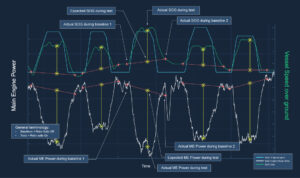
During the testing period, TR Lady sailed the Indian Ocean, South Atlantic, North and South Pacific, Southern Ocean and rounded both the Cape of Good Hope and Cape Horn, plus busy shipping routes, including the Strait of Malacca. Data from eight consecutive laden and ballast legs was analyzed to provide a long-term average of the fuel and emissions savings. The average net savings across this period, calculated from the verified performance model, were 1.9 tons of fuel per day and 7.0 tons of CO2 per day (well-to-wake). This equated to an average of 9.1% net propulsion fuel and emissions savings.
The achieved average savings align closely with Anemoi’s predicted 10% savings. Since TR Lady does not follow a fixed route, the results varied from voyage to voyage depending on the route taken and the wind conditions encountered. For example, on a 22-day voyage across the North Pacific, average route savings of 21% net propulsion fuel reduction were calculated from the verified performance model. However, the company highlighted that it is especially important for Anemoi to share the full, transparent picture in the first instance, rather than focusing solely on one particularly favorable route, to provide a more relevant measure of long-term performance.
Lloyd’s Register Advisory confirmed that the findings of this study validate Anemoi’s approach as a reliable method for calculating rotor sail performance. The statement of fact concluded that “there is close agreement between the predicted thrust coefficient trends and the measured values”.
Dr Dogan Uzun, ship performance consultant at Lloyd’s Register Advisory and project manager of the assessment, commented, “We have independently verified Anemoi’s methodology to calculate thrust power and predict fuel consumption, confirming its accuracy when ship-specific coefficients are correctly applied and kept up to date. Our assessment, drawing on high-frequency operational data and CFD analyses for rotor-sail-equipped vessels, highlights the value of detailed, vessel-specific modeling. The findings show that wind-assisted propulsion, when supported by robust data and transparent methods, can significantly reduce uncertainty and contribute meaningfully to emissions reduction in commercial shipping.”
Propelling sail boats into the future
In June 2023, TR Lady, an 82k DWT Kamsarmax, was installed with three Anemoi rotor sails, 5m in diameter and 24m in height – a shorter height and a lower aspect ratio than Anemoi’s standard products to suit air draft requirements. Anemoi has confirmed that testing is underway on several vessel installations featuring its larger rotor sails, measuring 35m in height, which, thanks to their higher aspect ratios, are expected to achieve even higher performance.
Clare Urmston, CEO of Anemoi Marine Technologies, said, “This independent verification is a crucial step in building trust across the industry. Lloyd’s Register Advisory’s rigorous and transparent approach gives shipowners and operators the confidence that our technology delivers measured fuel savings and emissions reductions in line with expectations. At Anemoi, we believe that credibility is earned through data, openness and accountability, and this verification underpins our commitment to setting a new standard as emerging technologies like wind propulsion pave the way in clean maritime innovation.”
Nicolas Tirogalas, chief investment officer and president of Tufton, shared, “Verifying the performance of rotor sails has been a key objective of this project for Tufton. The latest fuel consumption calculations, following the methodology independently verified by Lloyd’s Register Advisory, closely match our original expectations. We are excited by the results, which confirm not only the technology’s effectiveness but also the strong operational and environmental benefits we anticipated.”
Chris Hughes, decarbonization specialist at Cargill, said, “Building up an accurate understanding of the real-world, on-ship performance of technologies is a key piece in the wind-assist propulsion puzzle. By combining the data from more than 167 rotor on/off tests that were conducted by the TR Lady, together with the independent verification from LR, Anemoi instilled confidence in the accuracy of their analysis. We have already used the results of this study to fine-tune our weather routing digital twins for TR Lady. It will also help inform future decisions on deploying wind assist across our fleet.”
In related news, the French General Directorate for Maritime Affairs, Fisheries and Aquaculture (DGAMPA) recently placed the first order for Michelin’s WISAMO (Wing Sail Mobility) solution, which will be installed on a new deep-sea patrol vessel. Click here to read the full story.