


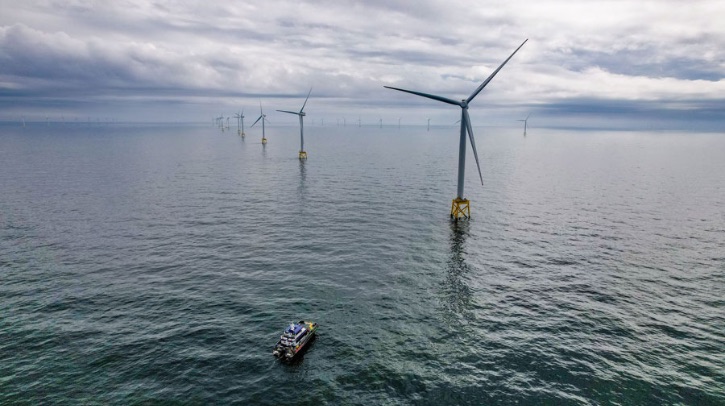
Green energy company ScottishPower Renewables has commissioned two studies to investigate the technical feasibility of offshore charging for both battery-powered crew transfer and service operation vessels.
The two reports – by MJR Power & Automation and Oasis Marine – are the last in a series of three commissioned by ScottishPower Renewables (SPR) to explore options for decarbonizing and reducing greenhouse gas (GHG) emissions from offshore windfarm operations.
Key findings
The studies consolidated initial findings that the electrification of offshore operations was technically feasible using battery-powered service operation vessels (E-SOVs), which stay out at sea for extended periods.
They also looked at the potential to decarbonize offshore operations using electric crew transfer vessels (CTVs) that could be used for windfarms located closer to shore, with findings confirming that it is technically and operationally feasible.
In both scenarios, the studies found that windfarms would also benefit environmentally and economically, with a significant reduction in both GHG emissions as well as annual fuel costs.
In particular, the Oasis Marine study identified that using electric CTVs, enabled by installing Oasis Power Buoys in the windfarm, provides protection from volatile fossil fuel price and the high costs of alternative green fuels. This, in turn, makes costs more be predictable and in line with the operator’s business model.
Its findings were based on the use of three electric CTVs instead of diesel-fueled vessels at a case study windfarm. The study identified potential savings of 140,000 metric tons of CO2 emissions and fuel saving costs of around £15m (US$20m) over the windfarm’s anticipated 25-year lifetime.
George Smith, chief technical officer at Oasis Marine, added, “We’re pleased to have worked with ScottishPower Renewables to conduct this study into the technical and operational feasibility of installing Oasis Power Buoy as an offshore charging solution in one of their wind farms.
“The study has concluded that the operations and maintenance activities of windfarms can be conducted by electric vessels. This is not only feasible but can deliver strong environmental and economic benefits. The report summarizes and generalizes the findings and gives an excellent snapshot of where Oasis Marine’s offshore charging technology is today and the potential emission and cost savings it unlocks.” 
Supporting Operation Zero
The findings are being shared through the Operation Zero initiative, which was launched at COP26 in Glasgow and brings together developers and supply chain companies committed to making zero-emission operations and maintenance vessels a reality.
Leo Hambro from the Operation Zero steering committee stated, “It’s great to see developers and the supply chain working together to develop the solutions and best practice that will be a game changer for the industry as a whole. Through studies like these, we will be able to learn, innovate and accelerate the adoption of zero-emission vessels and technologies to achieve a sustainable maritime future.”
Ross Ovens, ScottishPower Renewables’ managing director for offshore, said, “These latest studies have the potential to help the industry take a step closer to a new era for offshore windfarm operations – not just here in the UK, but right across the globe. The valuable depth and insight this research offers – regardless of whether you’re considering an SOV or CTV operating model – could help inform future windfarm operations as the country continues to build the green generation we need to meet the expected doubling of electricity demand.”
For more of the top insights into the future of offshore charging, readElectric and Hybrid Marine Technology’s exclusive feature “How are offshore charging facilities evolving for electric offshore support vessel demand?”, here