


Jin Wang, director of technology at ABS, discusses why nuclear energy’s potential can be viewed as two stories – nuclear for ships and nuclear for future fuels
Nuclear power has the potential to make a transformational impact on carbon emissions reduction across the electricity, industrial and transportation sectors. Its ability to optimize power generation in shipping has already attracted attention and the journey to cleaner maritime energy is gaining momentum.
From the perspective of achieving IMO’s 2050 net zero ambitions, it would be a mistake to ignore nuclear as a part of the fuel mix. However, progress will not happen without regulations that provide a foundational basis to how nuclear-powered systems in the maritime industry could look.
Nuclear energy has the potential to be a disruptor for the maritime sector. Enabling it to be successfully and safely integrated into the shipping industry requires a new kind of collaboration.
Nuclear power for ships holds out the prospect of using advanced small modular nuclear reactors as propulsion, while nuclear for future fuels includes scenarios where small modular nuclear reactors are positioned near shore to produce power for ports and support the production of alternative fuels.
Developing the systems that could power merchant vessels, provide shore power and generate clean fuels means bringing together players in marine and offshore design with builders of nuclear systems to fill knowledge gaps and exchange ideas.
ABS is playing a leading role in helping government and industry work toward the adoption of advanced nuclear technology, including key research with the US Department of Energy and multiple New Technology Qualification and Approval-in-Principal projects with industry.
ABS believes that nuclear energy’s potential in the maritime domain is much more than a reactor on a ship, however interesting this prospect.
The ability to connect consumers to external power generated by small modular nuclear reactors is a solution that would work in numerous applications. Floating offshore plants have considerable short-term potential to supply energy to offshore and onshore facilities.
In addition to net-zero emission electricity created by a small modular plant, the power barge concept could be extended toward the production of alternative fuels such as pink hydrogen and pink ammonia for consumption by onshore and offshore facilities.
Reflecting growing interest across the shipping and ports sector, ABS unveiled the industry’s first comprehensive rules for floating nuclear power plants at a forum for nuclear industry leaders held jointly with Idaho National Laboratory (INL) in October 2024.
The event saw presentations on the latest reactor technologies from leading companies and the presentation of a detailed study from ABS and Herbert Engineering Corporation (HEC) modeling the design, operation and emissions profile of a floating nuclear power plant.
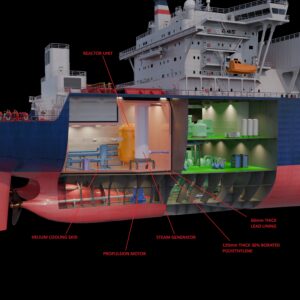
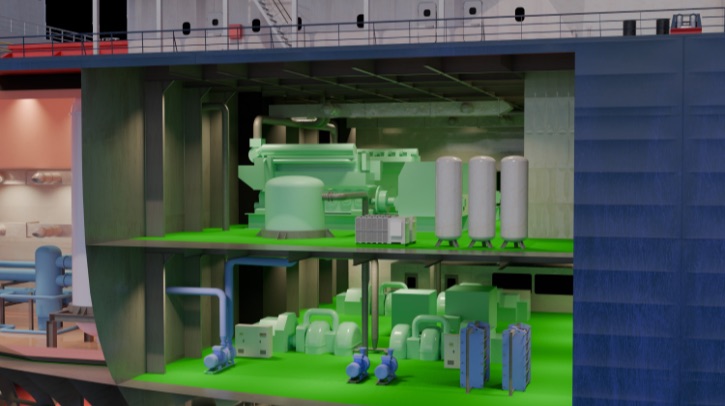
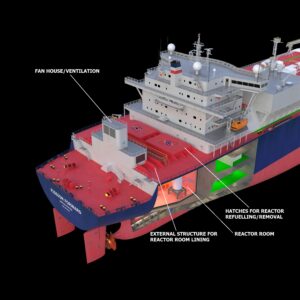
ABS and HEC subsequently unveiled a study examining the impact of a high-temperature, gas-cooled nuclear reactor (HTGR) on the design, operation and emissions of a 145,000m3 LNG carrier design.
The study is designed to help designers, owners and shipbuilders better understand the feasibility and safety implications of nuclear propulsion and to support future development projects.
While advanced reactor technology has been demonstrated on land, adapting it for marine applications is in its infancy. However, this study and the other research carried out by ABS clearly highlight its significant potential to address not only shipping’s emissions challenge but to deliver a range of other operational advantages to the industry.
The study proved vital in illuminating unintended design consequences and unforeseen risks that the class society would have to consider when developing its rules. Among the main challenges is how a nuclear-powered vessel would trade in practice, requiring the agreement of all countries in whose waters the ship would sail.
With the feasibility demonstrated for a small nuclear reactor on board a large containership, LNG carrier and an offshore platform, ABS expects continued interest in creating zero-emission vessels feasible for the marine sector through joint industry projects.
As this process continues, it is likely that regulation will prove the primary driving force in realizing full-scale projects. Lawmakers will play an important role in supporting the industry’s ambitions of reducing carbon emissions by enough to meet 2050 targets.
With advances in nuclear engineering and the development of many types of nuclear reactors come opportunities to implement the technology for commercial shipping and plant applications. ABS is encouraging both modular system providers and vessel designers to establish further joint industry projects that can investigate challenges and opportunities.